
Audio transcripts
Transcripts provide a written version of the dialogue and important ambient sounds in an audio clip, so the content can be accessible to a wider audience of people who can't listen.
What is a transcript?
A transcript provides a text version of the content in an audio file.
Primary audience
People who are deaf, are hard of hearing, or prefer to read a written transcript instead of listening to the audio.
Experience
In the audio player, tap Transcript to read the transcript in a new screen in addition to or instead of listening to the audio.
For more on the importance of including transcripts for accessibility, see W3C: Transcripts.
Transcript tips
- Break long chunks of text into short paragraphs of 2-3 sentences.
- Transcribe all speech verbatim.
- Don’t correct the speaker's use of language, paraphrase, add extra detail, or introduce abbreviations. You can cut excessive interjections (like “um”) if they’re distracting.
- Use rich text formatting to indicate spoken emphasis or different speakers.
- Write each speaker's name in bold, followed by a colon and paragraph break.
- Spell-check and check names of key people, places, artworks, etc.
- Look for and correct grammatical errors like extra spaces between sentences, punctuation, italicizing titles of artworks, etc.
- When you upload your transcript to the CMS, only include timestamps if they're helpful.
- Timestamps can add unnecessary clutter and can be distracting for the reader. If you do want to include timestamps, they usually do not need to be very granular and do not need to include end times.
- In Rev, "Timestamping" is an optional add-on to your order. If you generate a file with timestamps for other purposes (e.g., internal reviews, script editing), just uncheck "include timestamps" when you download the file to use it in Bloomberg Connects.
- Do not include links.
- Links interfere with Google Translate and cause errors in the CMS.
- Rev transcripts with timestamps might also include links that take you directly to a portion of the transcript in your workspace. Either manually delete these links, or follow Rev's guidance for downloading a transcript without links.
Audio without speech
Transcripts are useful for audio files that don't include speech or dialog. Noting relevant non-speech sounds like music, nature sounds, or other ambient information can help more visitors enjoy the breadth of your content.
In a transcript, non-speech sounds can be indicated in brackets to distinguish them from speech. For example, "[background laughter]...[birds chirping]...[car starting]...."
You can indicate the presence of music by referencing the title of the piece or by providing a brief description. For example, "[Song: Beethoven's Fifth Symphony]" or "[Soft classical music coming through an open window]".
Generate AI transcripts
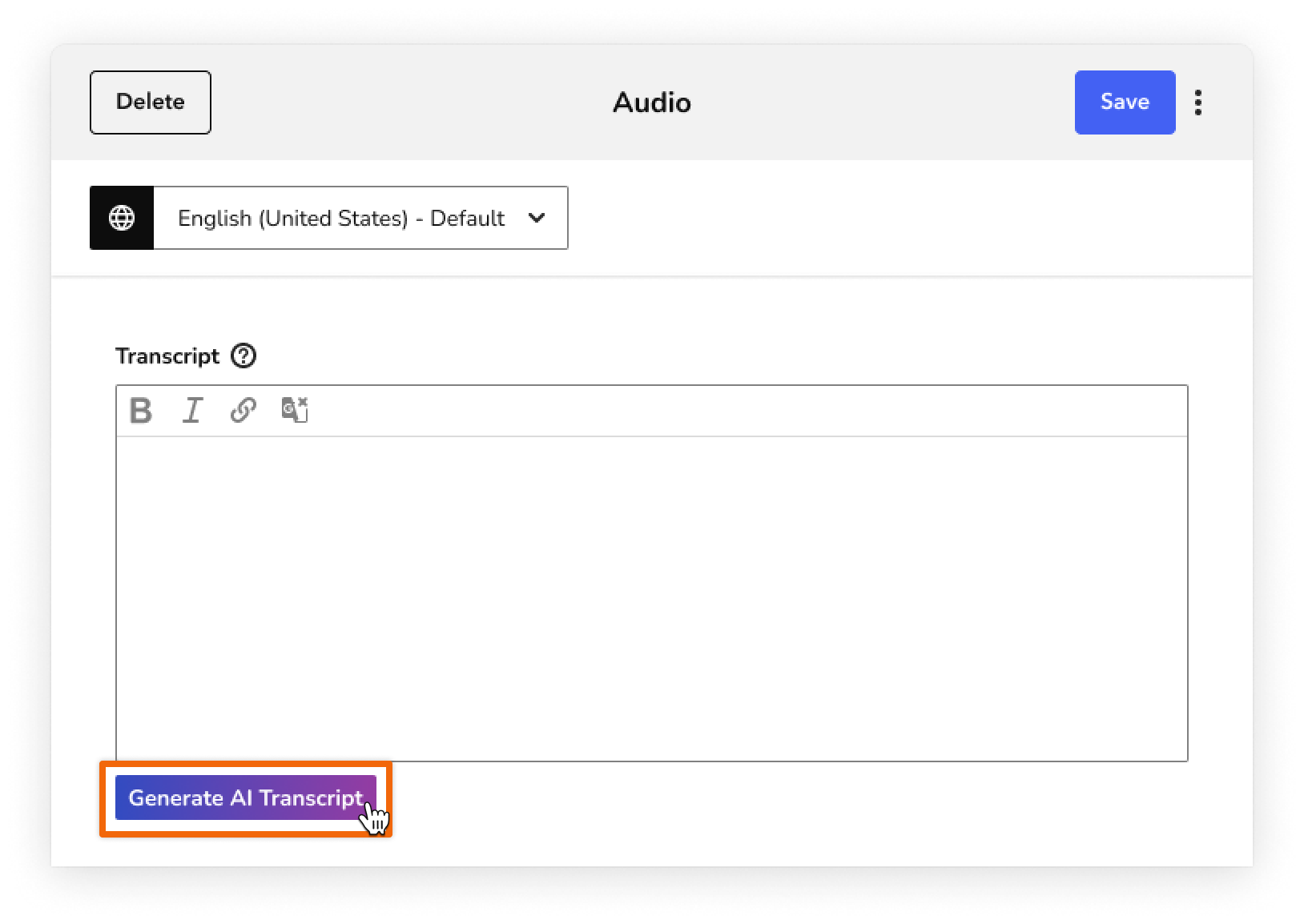
The AI audio transcription tool in the CMS offers a quick way to generate a text version of your audio content.
Note: This tool can’t recognize multiple speakers. For that and other advanced features, we recommend creating transcripts with Rev.
-
In any audio asset without a transcript, click Generate AI Transcript.
- After a few seconds, you can read and review the transcript.
- If you’re pleased with the overall result, you can click Accept (or Accept and Replace) to start reviewing and editing the transcript.
Because this content is generated by AI software, it’s crucial to review the transcription before you publish it to visitors. Here are some things to look for:
- The spelling of names, places, and other proper nouns. Transcription software sometimes misspells names, or mishears a name as two or more different words.
- Paragraph spacing. Remember to follow all of the transcript tips above, including breaking the transcription into several small paragraphs, rather than big blocks of text.
- Watch out for homophones, like “cymbal” and “symbol.”
- Uh, um, like. Keep an eye out for filler words and pauses in your AI transcript.